Agent Platform Deployment, Endpoints & Scheduling
Production‑grade model serving & continuous retraining on GCP
Project: AI‑GCP Pipeline‑3 · Endpoint lifecycle, traffic splitting, scheduled pipelines for model refresh. Online inference with managed Agent Platform Endpoints.
AI + MLOps Model Serving Blue/Green Deployment Agent Platform Scheduler
Project Summary
Model deployment & serving platform
Category
AI + MLOps · Cloud Platform Engineering
Domain
Model Deployment Engineering / AI Serving Platforms
Focus
Production online inference, endpoint management, retraining loops
Key technologies & concepts
Agent Platform serving stack
Problem & Objective
Why this deployment pipeline?
Problems solved
- Manual endpoint deployment → risk, drift, inconsistency
- No automated rollout or traffic management for new model versions
- Scheduled retraining missing → model stagnation
Primary objective
- Repeatable, production‑grade deployment pipeline with Agent Platform managed endpoints
- Versioned models, controlled traffic splits, scheduled retraining (continuous refresh)
Solution & Architecture
Deployment + retraining loop
Deployment pipeline design
Programmatic model upload to Agent Platform Model Registry, endpoint creation/reuse, traffic‑split deployment for new versions, and scheduled pipeline runs for continuous retraining & redeployment. All managed via Agent Platform SDK + KFP.
Autoscaling endpoints, versioned rollbacks, canary deployments — fully managed on GCP.
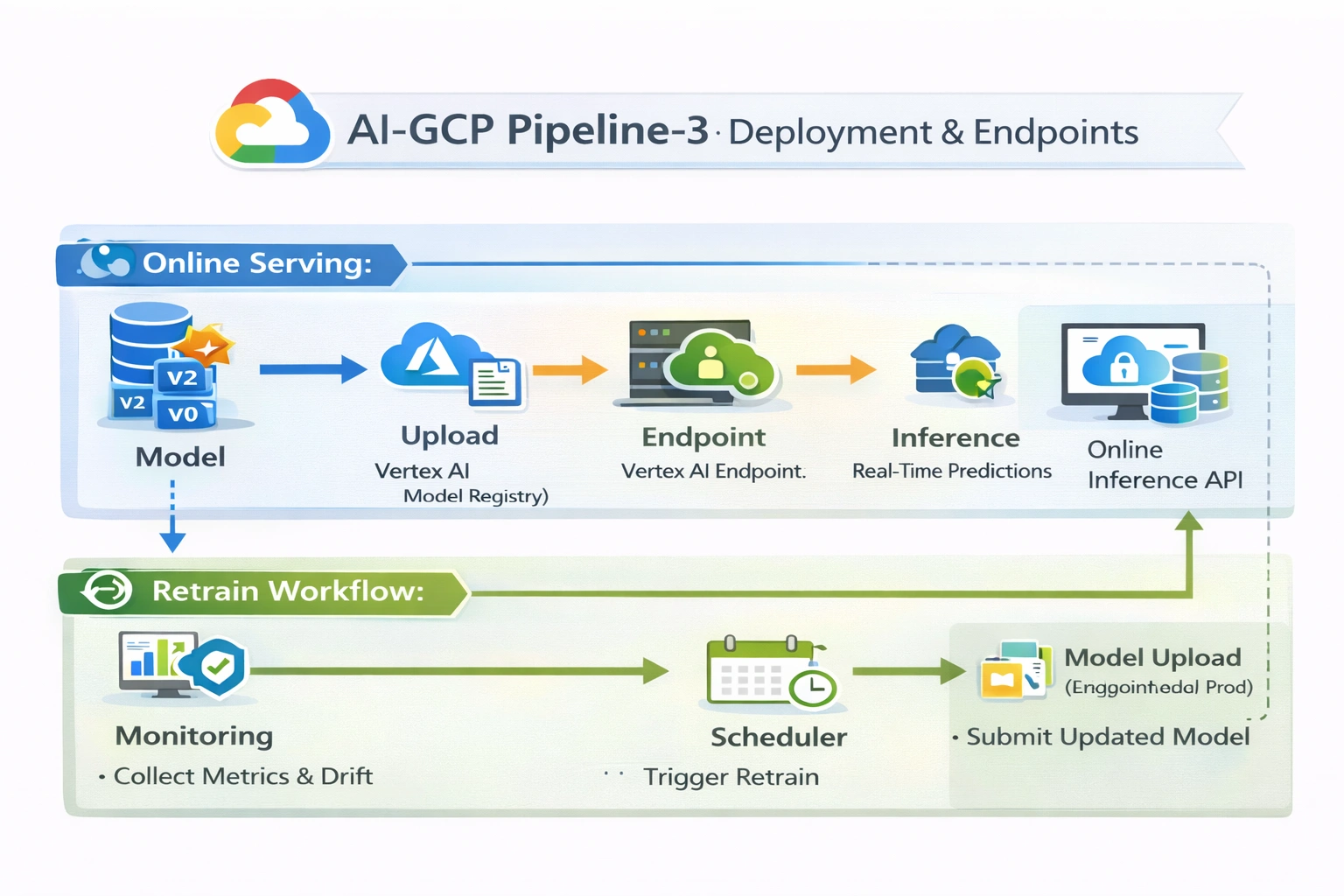
Key components (GCP)
- Agent Platform Model Registry (versioned models)
- Agent Platform Endpoints (managed inference)
- Agent Platform Pipeline Scheduler (cron retraining)
- GCS + Artifact Registry (artefacts & containers)
- Cloud Logging & Monitoring (observability)
- IAM service accounts (secure serving identity)
AI / DevOps Details
Model serving automation
AI/ML focus
Model Serving + Deployment Automation (MLOps – Online Inference)
Implemented automation
- Model upload to Agent Platform Registry
- Endpoint create/reuse logic
- Traffic‑split deployment (blue/green, canary)
- Scheduled pipeline runs for retraining
- Online prediction API invocation
Skills & Technologies
MLOps serving expertise
Primary skills
- AI Deployment Architecture (advanced)
- Agent Platform Endpoint Engineering (advanced)
- MLOps Production Deployment (advanced)
- Cloud AI Platform Engineering
Secondary tools
- Agent Platform SDK (Python)
- Kubeflow Pipelines v2
- scikit‑learn (model framework)
- GCS / IAM / Artifact Registry
GCP CI/CD · Architecture & YAML mapping
Pipeline‑3 (deployment) constructs
| Architecture Block | GCP CI/CD / MLOps Construct | YAML / Config Mapping |
|---|---|---|
| Source Repository | GitHub (deployment / pipeline definitions) | repository, workflow.checkout |
| Deployment Trigger | Agent Platform Pipeline output (approved model from Pipeline‑2) | approved_model_uri, pipeline_output |
| Deployment Orchestration | Agent Platform Model Upload + Endpoint Deployment APIs | components.upload-model, components.deploy-model |
| Serving Platform | Agent Platform Endpoints (managed online prediction) | endpoint.display_name, machine_type, min_replica_count |
| Online Inference API | Agent Platform Prediction Service (HTTPS endpoint) | predict.endpoint, instances, parameters |
| Traffic Management | Agent Platform Endpoint traffic split (blue/green / versioned deploy) | traffic_split, deployed_model_id |
| Artifact Storage | Google Cloud Storage (model artifacts) | artifact_uri: gs://..., model_dir |
| Model Registry | Agent Platform Model Registry (versioned models) | model.display_name, version_aliases |
| Approval Gate | Metric‑based gate in Pipeline‑2 (deployment only if threshold passed) | condition: metrics.accuracy >= threshold |
| Security & Auth | GCP IAM (Endpoint access control, Service Accounts) | service_account, roles/aiplatform.user |
| Secrets / Config | IAM roles + environment configs (optionally Secret Manager) | env, secretEnv, availableSecrets |
| Monitoring & Logs | Cloud Logging + Agent Platform Endpoint Metrics | logging.enabled, metrics.latency, metrics.errors |
| Model Performance Monitoring | Endpoint metrics (latency, request volume, errors) | monitoring_config, alert_policy |
| Scheduled Retraining | Agent Platform Pipeline Schedules (cron-based retraining jobs) | schedule.cron, max_concurrent_run_count |
| Closed‑Loop Feedback | Endpoint metrics → retraining pipeline → model re‑upload | feedback.metrics_uri, retraining_pipeline |
| Infrastructure Backend | Agent Platform Managed Endpoints (no Kubernetes / VM management) | managed_endpoint: true, dedicated_resources |
Enterprise‑scale model serving with traffic splitting, canary rollouts, and cron‑based retraining.
Complete Project Details
All content from the Pipeline‑3 PDF
Project Summary
- Project Name: AI‑GCP Pipeline‑3 – Agent Platform Deployment, Endpoints & Scheduling
- One‑Line Description: Production‑grade model deployment, endpoint management, online inference, and scheduled retraining on Google Agent Platform.
- Category: AI + MLOps + Cloud Platform Engineering
- Industry: Cross‑industry (Enterprise AI Platform / MLOps Infrastructure)
- Domain: Model Deployment Engineering / AI Serving Platforms
Key Words
- Agent Platform Model Upload (Model Registry Equivalent)
- Agent Platform Endpoints (Managed Online Inference)
- Model Versioning & Traffic Splitting
- Online Prediction APIs
- Agent Platform Pipeline Scheduling
- Blue/Green or Canary Deployment (Traffic Split)
- Artifact Registry (Serving Containers)
- GCS Model Artifacts
- Service Accounts & IAM (Secure Serving Identity)
- Cloud Logging & Monitoring (Inference Logs)
- Endpoint Lifecycle Management
- Production AI Serving Architecture
Problem Solved
Deploying ML models to production endpoints reliably on GCP requires handling model packaging, endpoint lifecycle, traffic management, and scheduled retraining. Manual deployment introduces risk, drift, and inconsistency.
Primary Objective
Build a repeatable, production‑grade deployment and serving pipeline on Agent Platform with managed endpoints, versioned models, automated rollout, and scheduled pipeline execution for continuous model refresh.
Solution & Architecture
Implemented an Agent Platform deployment pipeline that programmatically uploads trained models, provisions or reuses endpoints, deploys model versions with controlled traffic, and schedules periodic pipeline runs for continuous retraining and redeployment.
- Cloud Platform: Google Cloud Platform (Agent Platform)
- Key components: Agent Platform Model Registry (Model upload), Agent Platform Endpoints (Online inference), Agent Platform Pipelines Scheduler (Recurrent jobs), GCS (Model artifact storage), Artifact Registry (Serving container images), IAM Service Accounts (Secure serving identity), Cloud Logging & Monitoring (Endpoint observability)
- Scalability / Reliability: Managed Agent Platform Endpoints with autoscaling; traffic splitting for safe rollouts (canary/blue‑green); versioned deployments with rollback capability; scheduled retraining pipelines to prevent model drift; stateless serving with durable artifact storage in GCS
AI / DevOps Details
- AI/ML type or DevOps focus: Model Serving + Deployment Automation (MLOps – Online Inference)
- Models, pipeline, or automation: model upload automation to Agent Platform; endpoint creation & reuse logic; traffic‑split deployment for new versions; pipeline scheduling for continuous retraining; online prediction API invocation
- CI/CD, containerisation or orchestration tools: GitHub Actions (CI trigger), Agent Platform Pipelines (orchestration), Artifact Registry (serving containers), Agent Platform Endpoints (serving runtime)
Monitoring, Logging & Optimization
- Cloud Logging for inference requests
- Agent Platform Endpoint metrics (latency, throughput)
- Traffic shifting for rollout safety
- Scheduled pipeline runs for drift mitigation
Skills & Technologies Used
- Primary Skills: AI Deployment Architecture (Advanced), Agent Platform Endpoint Engineering (Advanced), MLOps Production Deployment (Advanced), Cloud AI Platform Engineering (Advanced)
- Secondary Tools / Frameworks: Agent Platform SDK (Python), Kubeflow Pipelines (KFP v2), scikit‑learn (model framework), Google Cloud Storage
- Programming Language: Python (primary), YAML (configuration / pipeline specs where applicable)
- Cloud & DevOps Tools: Google Agent Platform, Artifact Registry, GCS, IAM / Service Accounts, GitHub Actions, Agent Platform Pipeline Scheduler
Challenges & Outcomes
- Packaging models to match Agent Platform serving container requirements: resolved with standardized model artifact layout for Agent Platform containers
- Managing endpoint lifecycle (create vs reuse): resolved with programmatic endpoint discovery & reuse
- Safe rollout of new model versions: resolved with traffic‑split based deployment strategy
- Operationalizing scheduled retraining on GCP: resolved with Agent Platform Pipeline scheduling with controlled concurrency
GCP Production‑Grade Implementation Details
Architecture implemented on GCP: Trained models → Agent Platform Model Registry → Endpoint Deployment → Online Inference → Scheduled Pipeline Re‑runs.
- Top lane — Online Serving Path: Trained Model (from Pipeline‑2) → Agent Platform Model Upload (Model Registry) → Agent Platform Endpoint (Create / Reuse) → Online Inference API (Real‑Time Predictions)
- Bottom lane — Monitoring & Retraining Loop: Online Inference API / Endpoint → Monitoring & Logs (Cloud Logging, Metrics) → Scheduled Retraining (Agent Platform Pipeline Scheduler) → Back to Model Upload (Model Registry)
- Process Flow: Model Artifact (GCS) → Agent Platform Model Upload → Endpoint Provisioning / Reuse → Traffic‑Split Deployment → Online Inference API → Monitoring & Logs → Scheduled Pipeline Triggers
- The main project document has detailed view.
Assets & References
- GitHub / Repository Link: https://github.com/Rajesh-Arigala/vertex-ai-mlops-kfp2
- Notebook: Vertex_AI_kfp2_pipeline.ipynb
- Weblink: https://rajesharigala.com/mlops/ai4/ai4.3
- Proof Link: later
- Demo or Live Link: I will give the link later.
Study Material
- Public Study Material: Official documentation of KFP, YAML file for GCP, Python SDK; downloadable PDF if available
- Restricted Study Material: KFP file specific, Colab Google specific; downloadable PDF with access limited to authorised users
Reference Architecture Mapping
The Pipeline‑3 architecture maps source repository, deployment trigger, orchestration, serving platform, online inference API, traffic management, artifact storage, model registry, approval gate, security/auth, secrets/config, monitoring/logs, model performance monitoring, scheduled retraining, closed‑loop feedback, and infrastructure backend to GCP CI/CD / MLOps constructs.
Pipeline‑3 Summary
Enterprise‑scale model serving and lifecycle management on Google Cloud using Agent Platform Model Registry, Endpoints, and Pipeline Schedulers to operationalize approved models into secure, scalable online inference APIs. This layer establishes production deployment patterns, endpoint traffic management, continuous monitoring and logging via Cloud Logging/Metrics, and closed‑loop scheduled retraining pipelines, enabling continuous improvement, governed re‑deployments, and reliable real‑time ML services in production.
Challenges & Outcomes
Technical resolutions
Key challenges
- Packaging models for Agent Platform serving containers
- Endpoint lifecycle (create vs reuse) logic
- Safe rollout of new model versions
- Operationalizing scheduled retraining on GCP
Resolutions
- Standardized model artifact layout
- Programmatic endpoint discovery & reuse
- Traffic‑split deployment (blue/green, canary)
- Agent Platform Pipeline scheduling with concurrency control
Assets & References
Code, diagrams, study material