Agent Platform Foundation
Programmatic MLOps infrastructure on GCP
Project: AI‑GCP Pipeline‑1 · Provisioning a production‑ready GCP AI platform for Agent Platform pipelines using programmatic IAM, GCS artifact storage, and SDK‑driven MLOps bootstrap.
Cloud + MLOps AI platform engineering Kubeflow Pipelines v2
Project Summary
Agent Platform foundation
Category
Cloud + MLOps · AI Platform Infrastructure
Domain
AI Platform Engineering / MLOps (GCP Agent Platform)
Focus
MLOps Platform Engineering · infrastructure as code
Key technologies & concepts
GCP native MLOps stack
Problem & Objective
Why this platform bootstrap?
Problems solved
- Manual/ad‑hoc GCP AI setup → inconsistent Agent Platform environments, misconfigured IAM, insecure artifact access
- Fragile MLOps workflows, operational drift across dev/pre‑prod/prod
Primary objective
- Secure, reproducible GCP AI foundation via programmatic bootstrap (project context, IAM, GCS, pipeline runtime)
- Enable governed execution of downstream ML pipelines (Pipeline‑2 train, Pipeline‑3 deploy)
Solution & Architecture
Programmatic Agent Platform bootstrap
Platform foundation design
Programmatic bootstrap configures GCP project, enables Agent Platform APIs, provisions IAM service accounts (least‑privilege), creates GCS artifact root, and sets up Agent Platform Pipelines runtime context — all through SDK + config, eliminating console drift.
Infrastructure automation only (no models). Pipeline‑1 lays the secure, reproducible base for training & deployment pipelines.
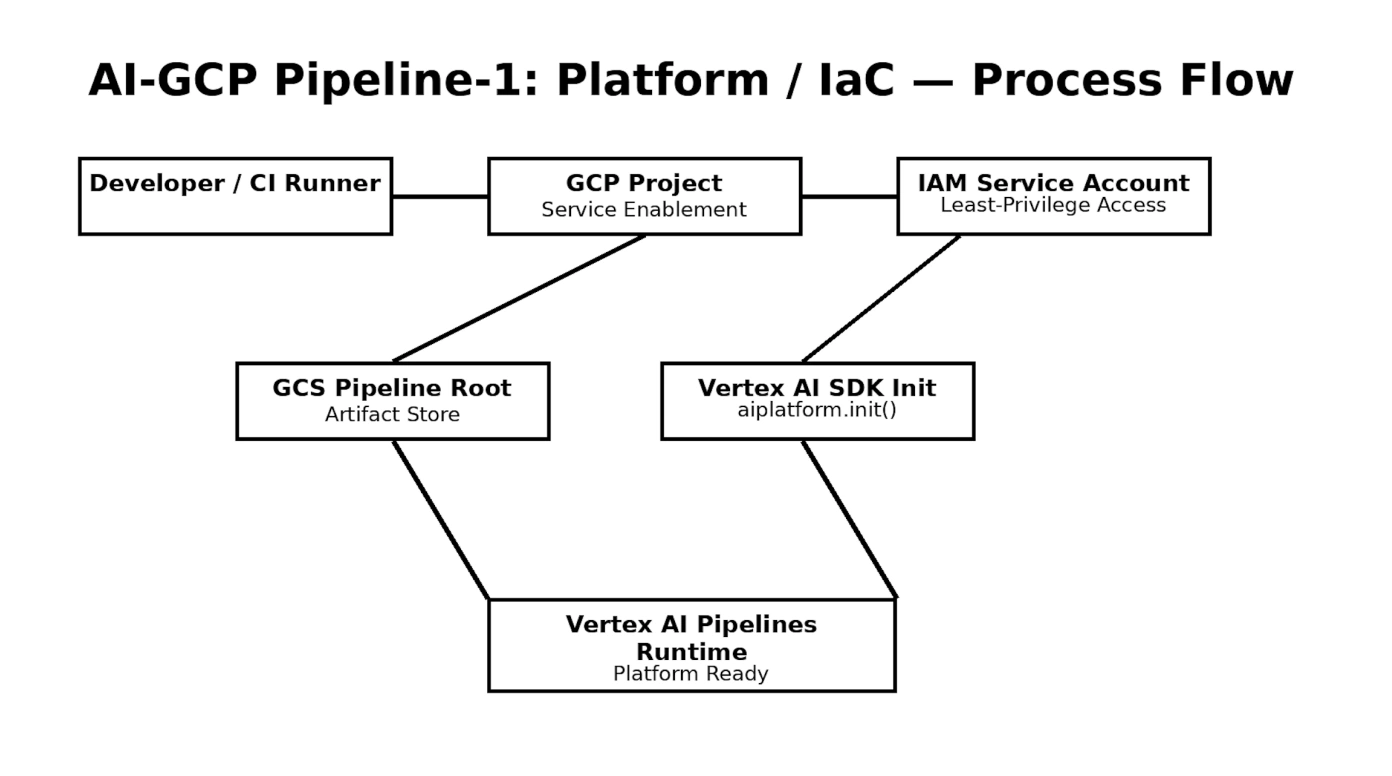
Key components (GCP)
- Agent Platform Pipelines (managed KFP runtime)
- IAM service accounts + impersonation
- GCS bucket for artifacts (pipeline root)
- Agent Platform SDK (Python) + gcloud
- Cloud Logging & Monitoring
- Workload Identity Federation (GitHub → GCP)
Handshake: Google Colab ↔ Google Cloud
Pipeline‑1 includes the secure handshake between Google Colab and Google Cloud so notebooks can initialize the same Agent Platform project, region, service account, and GCS pipeline root used by the production pipeline runtime.
- Colab authenticates the user or service account context with Google Cloud.
- The notebook sets
PROJECT_ID,REGION,BUCKET_URI, and the pipeline runner service account. aiplatform.init()establishes the Agent Platform SDK context for compile, submit, and monitor workflows.- GCS read/write permissions are validated before downstream Pipeline‑2 and Pipeline‑3 execution.
Skills & Technologies
MLOps platform expertise
Primary skills
- GCP Agent Platform Engineering (advanced)
- MLOps platform design (pipeline runtime, artifact mgmt)
- Kubeflow Pipelines v2 (advanced)
- GCP IAM least‑privilege design
- Cloud Storage for ML artifacts
Secondary tools
- Agent Platform Python SDK
- Google Cloud SDK (gcloud)
- Cloud Logging & Monitoring
- Python + YAML
- Git / GitHub
GCP DevOps CI/CD · Architecture & YAML Mapping
Pipeline‑1 platform bootstrap constructs
| Architecture Block | GCP CI/CD Construct (Pipeline‑1 – Platform) | YAML / Config Mapping |
|---|---|---|
| Source Repository | GitHub (IaC / Agent Platform bootstrap repo) | repository, checkout.path |
| Source Trigger | GitHub Actions trigger (push / workflow_dispatch) | on.push, on.workflow_dispatch |
| CI Runner | GitHub Actions Linux Runner (ubuntu-latest) | jobs.bootstrap.runs-on: ubuntu-latest |
| Platform Provisioning | Terraform / gcloud / Python SDK (Agent Platform, GCS, IAM bootstrap) | terraform apply, gcloud services enable, aiplatform.init() |
| Pipeline Runtime Setup | Agent Platform Pipelines (SDK init, pipeline root config) | pipeline_root: gs://..., location, project |
| Artifact Storage | Google Cloud Storage (GCS pipeline root: datasets, pipeline artifacts) | BUCKET_URI, artifact_uri, pipeline_root |
| Container Registry | Artifact Registry (base images for training / inference if needed later) | image.repository, image.tag |
| Service Identity | GCP Service Account (pipeline runner identity) | service_account, GOOGLE_SERVICE_ACCOUNT |
| Security & Auth | Workload Identity Federation (GitHub → GCP) + IAM Roles | workload_identity_provider, roles/aiplatform.user, roles/storage.objectAdmin |
| Secrets / Config | Secret Manager + environment variables (project, region, bucket) | env.PROJECT_ID, env.REGION, secrets |
| Approval Gate | Optional manual approval (GitHub Environments / PR review) | environment, required_reviewers |
| Monitoring & Logs | Cloud Logging + Agent Platform Pipelines UI | logging.enabled, pipeline_job_name |
| Lineage & Governance | Agent Platform Metadata Store (pipeline lineage, artifacts, metrics) | metadata.pipeline.name, artifact.uri, metrics |
| Infrastructure Backend | Terraform state (GCS backend) / gcloud-managed resources | backend "gcs", bucket, prefix |
Pipeline‑1 is the enterprise-grade GCP platform bootstrap: GitHub Actions + Workload Identity Federation securely provision Agent Platform Pipelines runtime, IAM service accounts, GCS artifact stores, and governance foundations for downstream AI workflows.
Complete Project Details
All content from the Pipeline‑1 PDF
Project Summary
- Project Name: AI‑GCP Pipeline‑1: Agent Platform Foundation (Programmatic MLOps Infrastructure)
- One‑Line Description: Provisioning a production‑ready GCP AI platform foundation for Agent Platform pipelines using programmatic IAM, GCS artifact storage, and SDK‑driven MLOps bootstrap.
- Category: Cloud + MLOps (AI Platform / Infrastructure Foundation)
- Industry: Cross‑Industry (Enterprise AI Platforms / Cloud Infrastructure)
- Domain: AI Platform Engineering / MLOps Infrastructure (GCP Agent Platform)
Key Words
- Google Agent Platform (AI Platform Foundation)
- Kubeflow Pipelines (KFP v2 Runtime for ML Orchestration)
- Google Cloud IAM (Service Accounts & Least‑Privilege Policies)
- Google Cloud Storage (GCS Artifact Store for Pipelines)
- Agent Platform SDK (Programmatic Platform Bootstrap)
- Google Cloud Projects & APIs (Agent Platform Enablement)
- Programmatic Infrastructure Provisioning (SDK + gcloud)
- ML Platform Bootstrapping (Pipeline Runtime Setup)
- Multi‑Environment Platform Setup (Dev / Pre‑Prod / Prod via Config)
- Pipeline as Code (KFP v2 Pipeline Specs)
- Agent Platform Pipelines Runtime (Managed ML Orchestration)
- Service Account Impersonation (Secure Pipeline Execution)
- Cloud Logging & Monitoring (Agent Platform / Cloud Logging)
- Artifact Lineage & Storage (GCS + Agent Platform Metadata)
- Cost‑Aware Platform Defaults (Region, Machine Types, Quotas)
Problem Solved
Manual and ad‑hoc setup of GCP AI infrastructure leads to inconsistent Agent Platform environments, misconfigured IAM/service accounts, insecure artifact access, and non‑reproducible ML pipelines. This creates fragile MLOps workflows, operational drift across environments, and difficulty scaling ML workloads reliably across teams.
Primary Objective
Establish a secure, reproducible GCP AI platform foundation by programmatically bootstrapping project context, IAM service accounts, artifact storage (GCS), and pipeline runtime configuration—enabling consistent, governed execution of MLOps pipelines across environments without console‑driven dependencies.
Solution & Architecture
The solution implements a programmatic Agent Platform bootstrap that configures the GCP project context, initializes services, provisions and wires GCS artifact storage, and sets up IAM service accounts with least‑privilege access for pipeline execution. This creates the standardized AI platform foundation on GCP on top of which Pipeline‑2 (Train/Evaluate/Register) and Pipeline‑3 (Deploy/Serve/Schedule) run.
- Cloud Platform: Google Cloud Platform (GCP) – Agent Platform
- Components: Google Agent Platform (Pipelines, Model Registry, Endpoints runtime), Kubeflow Pipelines (KFP v2 SDK), Google Cloud IAM, GCS, Agent Platform SDK for Python, Google Cloud Projects & APIs, Cloud Logging & Monitoring
- Reliability: managed scalability, stateless orchestration, reproducible platform bootstrap, least‑privilege IAM, durable GCS artifacts
AI / DevOps Details
- Focus: DevOps / MLOps Platform Engineering (AI Platform Foundation on GCP Agent Platform)
- Automation: infrastructure automation only—project context initialization, IAM service account wiring, GCS artifact storage configuration, and pipeline runtime setup
- Scope: no ML models or training pipelines in Pipeline‑1; modelling and deployment are handled in Pipelines 2 & 3
- Tools: Kubeflow Pipelines (KFP v2), Agent Platform Pipelines, Agent Platform SDK (Python), Google Cloud IAM, GCS, optional GitHub Actions or Cloud Build
Monitoring & Optimization
- Agent Platform Pipelines UI for run status, DAG visualization, step‑level logs, and diagnostics
- Google Cloud Logging for component logs, pipeline execution logs, troubleshooting, and audit
- GCS + Agent Platform metadata for dataset, model, and artifact traceability
- Componentized steps for isolated failure handling and re‑runs
- Cost‑aware defaults for region, machine types, and scheduling choices
Skills & Technologies Used
- Primary: GCP Agent Platform Engineering, MLOps Platform Design, Kubeflow Pipelines (KFP v2), GCP IAM & Service Accounts, Cloud Storage for ML Artifacts — Advanced
- Secondary: Google Cloud SDK (gcloud), Agent Platform Python SDK, Google Cloud Logging & Monitoring, Python virtual environments / Conda, Git & GitHub
- Languages: Python (primary), YAML (configuration / pipeline specs where applicable)
- Cloud & DevOps: GCP Agent Platform, Agent Platform Pipelines, KFP v2, Cloud Logging & Monitoring, Google Cloud SDK
Challenges & Resolutions
- IAM service accounts for Agent Platform Pipelines to access GCS without over‑permissioning → dynamic service account resolution and least‑privilege IAM roles
- Reproducible setup across local and Colab environments → programmatic platform bootstrap using SDK + gcloud
- SDK initialization and pipeline runtime context across projects/regions → standardized
aiplatform.init()project/region initialization - Artifact paths and permissions on managed infrastructure → dedicated GCS pipeline root with explicit read/write permissions
GCP Production‑Grade Implementation Details
Pipeline‑1 provisions the AI platform foundation on GCP, including project context initialization, IAM service accounts for secure pipeline execution, GCS artifact storage for datasets/models, and Agent Platform Pipelines runtime configuration. This platform layer is the standardized base for Pipeline‑2 and Pipeline‑3.
- Architecture: Source Control → Secure CI/CD Identity → GCP Project & IAM → Agent Platform Pipelines Runtime → GCS Artifact Store → Governance Baseline
- Top lane — Platform Provisioning & Security Foundation: GitHub Repository (IaC / Platform Code) → GitHub Actions CI/CD Pipeline → Workload Identity Federation (GitHub → GCP) → GCP IAM Service Accounts (Least Privilege) → Agent Platform Pipelines Runtime Environment → Google Cloud Storage (Artifacts / Pipeline Root)
- Bottom lane — Governance, Lineage & Execution Context: GCP Project + Org Policies → IAM Roles & Permissions (Pipelines, Storage, Agent Platform) → Agent Platform Pipelines Execution Context → Centralized Logging & Audit (Cloud Logging) → Standardized Platform Baseline for All ML Pipelines
- The main project document has detailed view.
Assets & References
- GitHub / Repository Link: https://github.com/Rajesh-Arigala/vertex-ai-mlops-kfp2
- Notebook: Vertex_AI_kfp2_pipeline.ipynb
- Weblink: https://rajesharigala.com/mlops/ai4/ai4.1
- Proof Link: later
- Demo or Live Link: I will give the link later.
Study Material
- Public: Official documentation of KFP, YAML file for GCP; downloadable PDF if available
- Restricted: KFP file specific, Colab Google specific; downloadable PDF with access limited to authorised users
Pipeline‑1 Summary
Enterprise‑grade platform bootstrap on Google Cloud using GitHub Actions + Workload Identity Federation to securely provision Agent Platform Pipelines runtime, IAM service accounts, GCS artifact stores, and governance foundations for production ML pipelines. This layer standardizes security, storage, lineage, and execution context for all downstream AI workflows.
Challenges & Outcomes
Technical resolutions
Key challenges
- Correctly wiring IAM for Agent Platform Pipelines to access GCS without over‑permissioning
- Reproducible setup across environments (local vs Colab)
- Configuring SDK init + pipeline root for different projects/regions
Resolutions
- Dynamic service account resolution + least‑privilege IAM roles
- Programmatic platform bootstrap (SDK + gcloud) → consistency
- Standardized platform.init() and dedicated GCS pipeline root with explicit permissions
Assets & References
Code, diagrams, study material